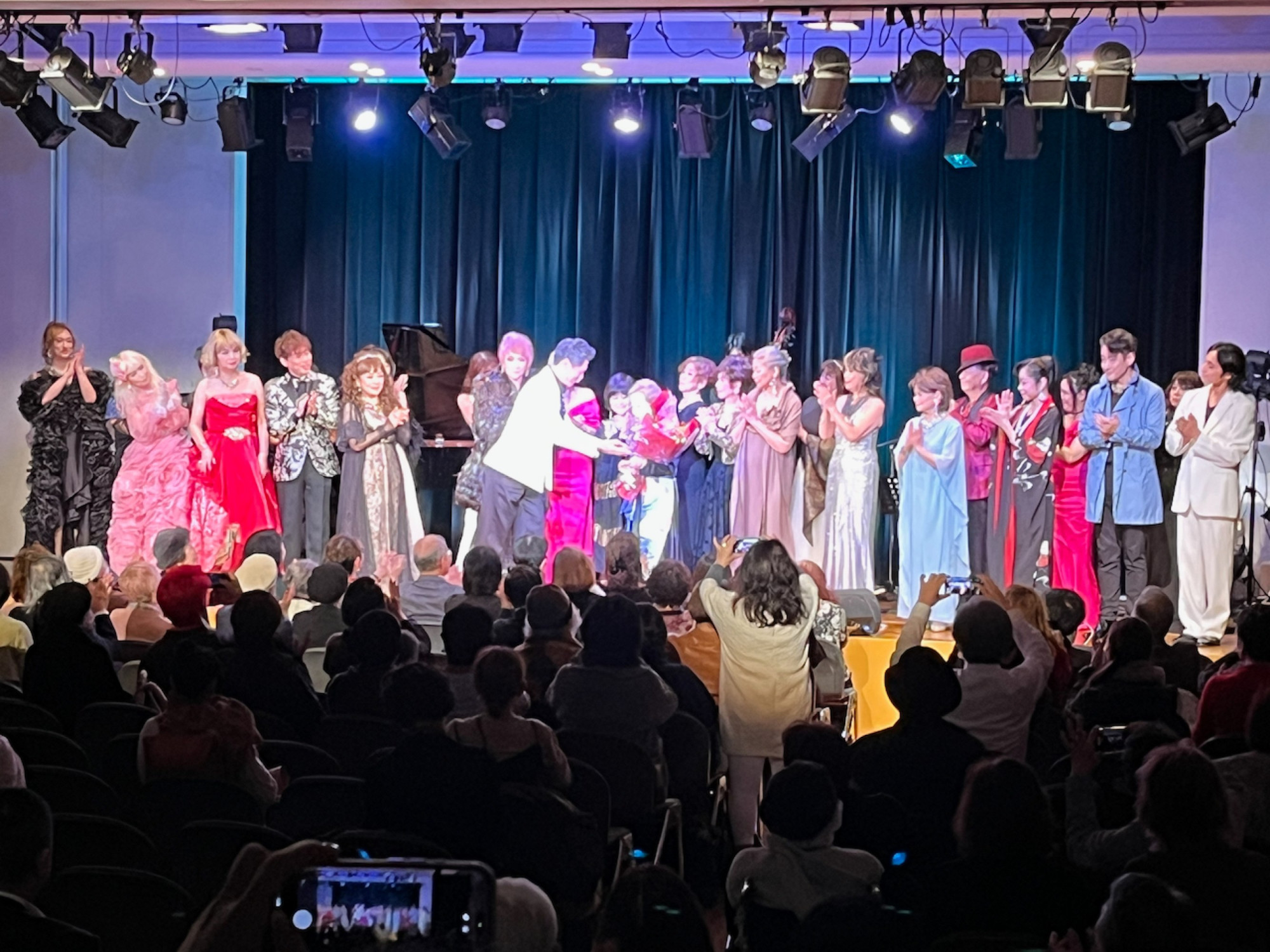
Every fall for the last several years we have attended a unique concert experience in Tokyo. The concert is dedicated to Chanson, a traditional style of French pop music. In Chanson, words, poetry, and narrative are often featured over complex melodies. Chanson has enjoyed a dedicated, passionate subculture in Japan for decades, often celebrated through community festivals and specialized music lounges.
Chanson became most popular in Japan after the war, from the late 1940s to the early 1950s. This mid-century "chanson boom" fundamentally altered Japanese performance styles, acting as a crucial, uncredited catalyst for modern enka by introducing the dramatic, single-microphone storytelling and cabaret-style orchestration that now define the genre.
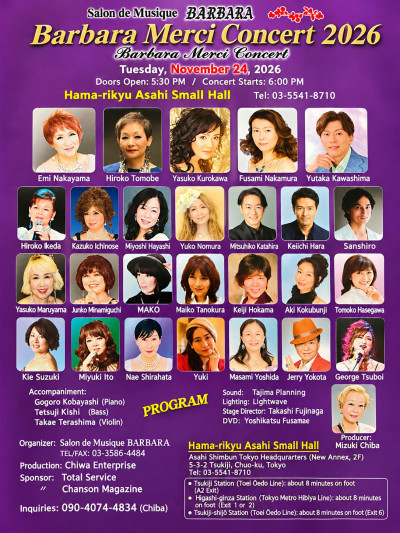
This year's Barbara Merci Concert 2026 was produced by Salon de Musique BARBARA, a specialized "chansonnier" lounge located in Akasaka, Minato-ku, Tokyo. The lounge is named in honor of the legendary French singer-songwriter Barbara. Born Monique Andrée Serf in 1930, Barbara was best known for her poetic chanson and French pop music. Mizuki Chiba, a well-known figure in the Japanese Chanson community, is founder and owner of the Salon. (I believe the gala is produced by the Salon every year, but I could not verify that.)
 |
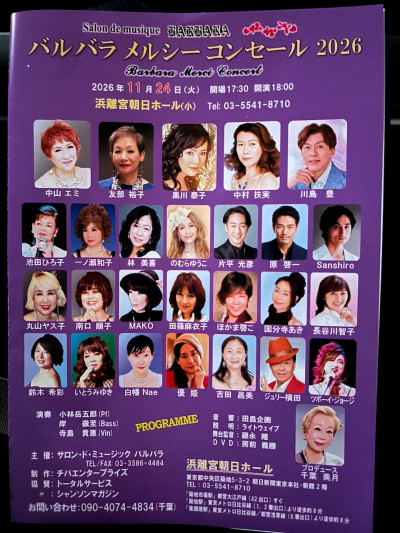 |
Salon de Musique BARBARA regularly hosts rotating nightly acts in an intimate setting. Toward the end of each year the lounge assembles many of their regular vocalists and musicians to say "thank you" (merci) to their community and patrons. The concert is held at a different venue every year. This year it was held at Hamarikyu Asahi Hall in Tsukiji, Tokyo.
How was the concert? Very interesting, though it is not necessarily my cup of tea.
The evening started with Ms. Chiba coming on stage to welcome everybody to the show. Then, the music started, and the singers began appearing on stage, one by one. Ms. Chiba, as well as all of the performers, was wearing very glamorous clothing. In Chanson, a singer's wardrobe acts as a direct extension of the music, functioning as a vital storytelling tool. Because Chanson numbers operate like miniature, emotionally charged theater scenes, the performers use vibrant colors, sequins, and dramatic silhouettes to visually broadcast the mood of a song.
Twenty four different vocalists belted out their interpretations of Chanson songs, as well as some songs that were clearly not Chanson. There was a first musical segment, an intermission, and then a second musical segment. The first segment was dedicated strictly to Chanson. The second segment was a conglomeration of Chanson and some very well-known songs that are not Chanson at all. One example from the concert was the famous song by Dolly Parton, "I Will Always Love You."
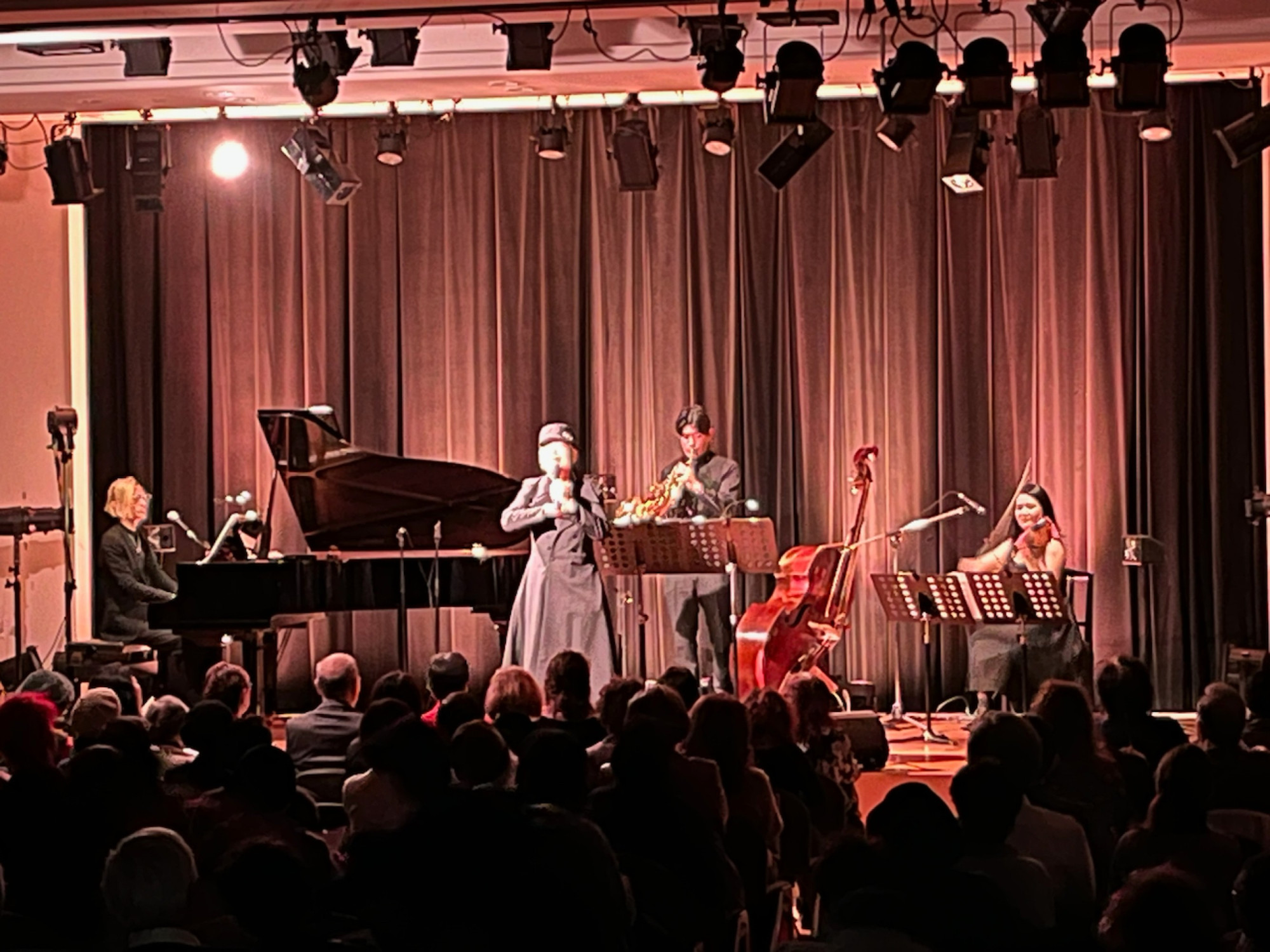
Each singer sang twice during the evening - one time in each segment. So the stage was like a revolving door of singers. After their song was finished, the singer exited the stage promptly, and the next singer appeared like clockwork.
I will give a big shout out to the band. As I said, I am not a big fan of Chanson, but the band did a great job accompanying the songs with excellent beat and tone. The musical ensemble was directed by Gogoro Kobayashi on piano, with Tetsuji Kishi on bass and Takae Terashima on violin.
After the last song, the vocalists gathered on stage to say farewell. Ms. Chiba said a few closing words, and thanked the singers for participating in this year's concert.
How did we get tickets? Well, we have a friend that is a big Chanson fan, and so he gets tickets for us every year, without asking. I think he wants to make fans of us too.
So I expect we'll attend the concert again next year. Frankly, after researching what Chanson is all about, I am more interested than ever.
場所
このレッスンのイディオム
筆者は、次の歌手が like clockwork に登場したと言っています。つまり、歌手の交代がスムーズで素早く、時間どおりに次々と行われたという意味です。
“After their song was finished, the singer exited the stage promptly, and the next singer appeared like clockwork.”
直訳
例文
- The train leaves at 8:05 every morning like clockwork. その電車は毎朝8時5分に、きまって正確に出発します。
- After we set up the new system, everything started running like clockwork. 新しいシステムを導入してから、すべてが順調に回り始めました。
- Her alarm goes off like clockwork at 6:30. 彼女の目覚ましは、毎日6時30分になるときっちり鳴ります。
- The meeting started like clockwork, right on time. 会議は時刻どおりに、ぴったり始まりました。
由来・メモ
筆者はシャンソンのコンサートを興味深いと感じましたが、not my cup of tea だと言っています。つまり、この音楽のスタイルは自分の好みではないという意味です。
“Very interesting, though it is not necessarily my cup of tea.”
直訳
例文
- Horror movies are not my cup of tea. ホラー映画はあまり好きじゃない。
- Thanks for inviting me, but loud parties are not my cup of tea. 誘ってくれてありがとう。でも、大音量のパーティーはあまり好みじゃない。
- That style of music is not my cup of tea. あの音楽のスタイルは自分の好みではない。
- I tried the game, but it was not my cup of tea. そのゲームをやってみたけど、あまり自分には合わなかった。
由来・メモ
単語
ここでの subculture は、社会の中で特定の趣味(ここではシャンソン)を共有する小さな集団のことです。
本文より“Chanson has enjoyed a dedicated, passionate subculture in Japan for decades, often celebrated through community festivals and specialized music lounges.”
-
The city has a vibrant subculture of street artists.その都市には、活気のあるストリートアーティストのサブカルチャーがあります。
-
That music became the symbol of a youth subculture.その音楽は若者のサブカルチャーの象徴になりました。
ここでの catalyst は、大きな変化や新しいもの(現代の演歌)が生まれるきっかけになったもののことです。
本文より“This mid-century "chanson boom" fundamentally altered Japanese performance styles, acting as a crucial, uncredited catalyst for modern enka by introducing the dramatic, single-microphone storytelling and cabaret-style orchestration that now define the…”
-
Her speech was the catalyst for major reform.彼女のスピーチが大きな改革の触媒となりました。
-
The enzyme acts as a catalyst in the reaction.その酵素はその反応で触媒として働きます。
ここでの orchestration は、曲をいろいろな楽器で演奏できるように編曲・構成することです。
本文より“…as a crucial, uncredited catalyst for modern enka by introducing the dramatic, single-microphone storytelling and cabaret-style orchestration that now define the genre.”
-
The orchestration of the event took months of planning.そのイベントの調整には何か月もかかりました。
-
The orchestration of the song gave it a rich, dramatic sound.その曲のオーケストレーションによって、豊かで劇的な音になりました。
ここでの founder は、そのサロンを最初に作った人のことです。
本文より“Mizuki Chiba, a well-known figure in the Japanese Chanson community, is founder and owner of the Salon.”
-
She is the founder of a successful nonprofit organization.彼女は成功した非営利団体の創設者です。
-
The company's founder gave a speech at the anniversary event.その会社の創設者は記念イベントでスピーチをしました。
ここでの gala は、公演などがある華やかで特別な催しのことです。
本文より“(I believe the gala is produced by the Salon every year, but I could not verify that.)”
-
They attended a charity gala downtown.彼らはダウンタウンで開かれたチャリティーの祝賀会に参加しました。
-
The school hosted a gala to celebrate its 50th anniversary.その学校は創立50周年を祝う盛大な催しを開きました。
ここでの glamorous は、おしゃれで華やか、とても目を引くという意味です。
本文より“Ms. Chiba, as well as all of the performers, was wearing very glamorous clothing.”
-
The actress looked glamorous on the red carpet.その女優はレッドカーペットでとても華やかに見えました。
-
Modeling may seem glamorous, but it is hard work.モデル業は華やかに見えるかもしれませんが、実際は大変な仕事です。
ここでの intermission は、公演の前半と後半の間の短い休憩のことです。
本文より“There was a first musical segment, an intermission, and then a second musical segment.”
-
We bought snacks during the intermission.私たちは休憩時間に軽食を買いました。
-
The audience left their seats at intermission.観客は幕間に席を立ちました。
ここでの conglomeration は、いろいろな種類の曲を寄せ集めたものという意味です。
本文より“The second segment was a conglomeration of Chanson and some very well-known songs that are not Chanson at all.”
-
The museum is a conglomeration of art from many cultures.その博物館は多くの文化の芸術が集まった集合体です。
-
The media conglomeration owns newspapers, TV stations, and websites.そのメディア複合企業は新聞、テレビ局、ウェブサイトを所有しています。
ここでの accompanying は、歌手の歌に合わせて楽器で伴奏することです。
本文より“As I said, I am not a big fan of Chanson, but the band did a great job accompanying the songs with excellent beat and tone.”
-
As I said, I am not a big fan of Chanson, but the band did a great job accompanying the songs with excellent beat and tone.先ほども述べたとおり、私はシャンソンの大ファンというわけではありませんが、バンドは素晴らしいビートと音色で見事に歌の伴奏を務めていました。
-
The piano part was accompanying the singer during the whole song.曲の間ずっと、ピアノパートが歌手の伴奏をしていました。
ここでの ensemble は、一緒に演奏する音楽家の小さなグループのことです。
本文より“The musical ensemble was directed by Gogoro Kobayashi on piano, with Tetsuji Kishi on bass and Takae Terashima on violin.”
-
The jazz ensemble received a standing ovation.そのジャズアンサンブルは総立ちの拍手を受けました。
-
She wore a stylish black ensemble to the party.彼女はパーティーにおしゃれな黒の一式の服を着ていきました。
クイズ
このシリーズの次のレッスン
 レッスン 2 / 3
2020年オリンピック-日本対アメリカ野球
いやあ、これは予想外でした。日本チームの劇的な勝利ですね!投手戦がお好きなら、まさにうってつけの試合でした。
次のレッスンへ
このレッスンはいかがでしたか?
ご質問やご感想をお気軽にどうぞ。すべて目を通しています。